Posts

Drymonia variegata

Image
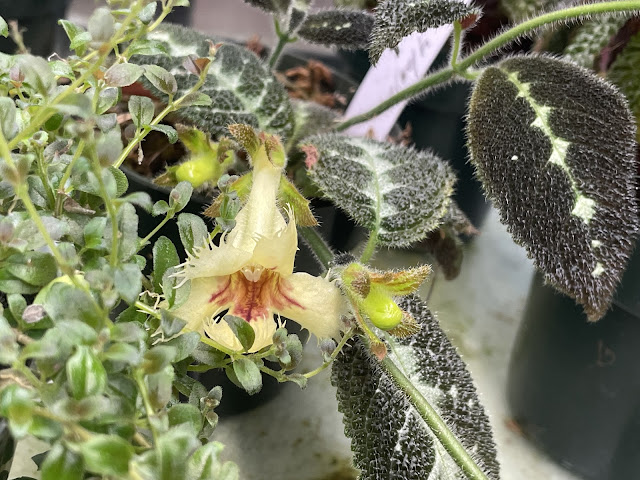
Drymonia variegata is an attractive, vining plant that I enjoyed growing the plant many years ago and was excited to acquire a small plant last spring. I restarted that plant with a small cutting, which quickly rooted.  The species is native to Colombia, Ecuador, and Panama. It is found on wet environments. I grow it in long-fiber sphagnum moss, enclosed in an aquarium / terrarium, under a shaded LED bulb. It is joined there by other humidity-loving plants such as Neomortonia rosea, Nautilocalyx pemphidius, Nautilocalyx pictus 'Jade'. Drymonia variegata The dark green foliage with silver "pine tree" markings makes for a stunning display on their own. I don't recall ever blooming Drymonia variegata in the past. I was surprised when I noticed a bud on the plant a month ago. Watching it intensely didn't seem to speed up the opening! As luck would have it, I was out of town for the weekend when the first bloom opened. Fortunately, my wife grabbed a few pictures...

Gloxinia erinoides 'Red Satin'

Image
Gloxinia erinoides 'Red Satin' is an easy to grow plant which is ideal for small spaces. The species is found in northern South America and Central America. The 'Red Satin' variety has small white dots on the dark green foliage with the small flowers held above the plant on red inflorescences. Gloxinia erinoides was formerly called Koellikeria erinoides before a revision of the Gloxinia. Gloxinia erinoides 'Red Satin' I grew this plant from seed obtained from The Gesneriad Society seed fund, which I sowed in February of this year. The seed germinated quickly, and I potted up two groups of seedlings into 3" pots in June. By early July the plants were putting out the stalks of diminutive flowers. The display is quite attractive. Gloxinia erinoides 'Red Satin' As an added bonus,  Gloxinia erinoides is one of the few scented gesneriads. Despite their small size, the flowers have a strong scent of coconut, tinged with a touch of vanilla. Although o...

Gesneriads at the Missouri Botanical Garden

Image
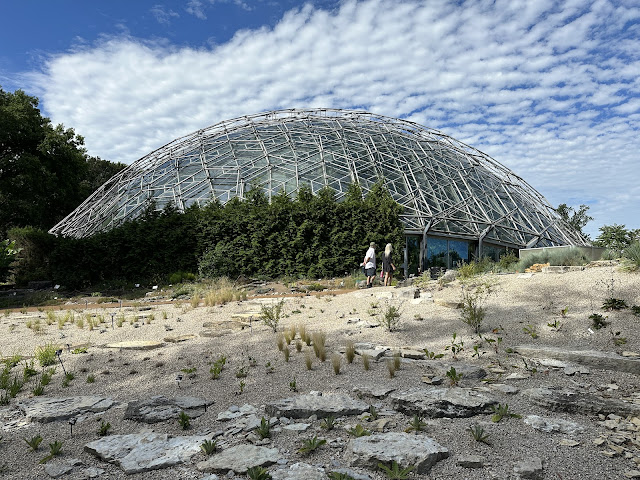
One of the field trips during the Gesneriad Society convention in July was a visit to the Missouri Botanical Garden, including a tour through the Climatron. Josh Higgins, a garden employee and gesneriad enthusiast gave us a tour during which he pointed out the many gesneriads hiding among the plants throughout the glasshouse.  The Climatron Moussonia deppeana was the first gesneriad spotted. The small shrub is found from Mexico to Guatemala. The attractive foliage tinted by red hairs stood out amount the greenery. Alas, no blooms were seen. Mousonnia deppeana I spotted Drymonia chiribogana from a distance. The large distinctively-veined leaves make it easy to see. This Ecuadorian native is easy to grow. Depsited developing into a tall plant, it blooms easily under lights. I find the bloom trend to be at the base of the planet so it can be kept manageable with pruning.  Drymonia chiribogana Flowering plants of Primulina tatiana were seen growing in the understory at several ...

Nautilocalyx glandulifer - A Beautiful Foliage Display

Image
Nautilocalyx glandulifer is an extremely attractive plant with dark purple-green leaves covered with purple hairs. The species is endemic to Ecuador. It seems to prefer lower light levels and high humidity. I've been growing this species since obtaining a cutting in July 2023. The stems root easily and it's a moderately fast grower. I grow this plant wicked in my usual three-part potting mix. It is subject to getting dry edges on the foliage in my conditions. It would likely do even better growing enclosed, if I had a large enough container. Nautilocalyx glandulifer N. glandulifer is a spreading, semi-trailing stems. My main plant, though still in a 4" pot, now covers almost an entire plant tray on the shelf. The leaves are arranged in alternate pairs. Usually. Alternate leaf pairs As I said, usually. One stem on my plant exhibits the leaves in whorls of three. Leaves of three The anomalous leaf pattern has been stable since I first noticed it last fall. I have not tried ...

Diminutive Phinaea From Seed

Image
One of the most enjoyable aspects of growing gesneriads is the ease with which new plants can be grown from seed. And one of the benefits of membership in The Gesneriad Society is access to an extensive list of seed, both species and assorted hybrid crosses.  I planted a batch of different seeds from the TGS Seed Fund at the end of February, including the two species mentioned in this post. After about five weeks, the strongest seedlings of  Phinaea multiflora 'Tracery' and  Phinaea albolineata were moved into 3" pots, several to a pot.  The first blooms on Phinaea multiflora 'Tracery' opened in early June.  Phinaea albolineata followed in mid-July.  Phinaea multiflora 'Tracery'   and  Phinaea albolineata The plants are similar with small white, short-lived flowers and silver veined foliage. At the same time, they are quite unique. I am growing both on wicks, in the open on my light stands. They both also make wonderful terrarium plants. When...

2024 Gesneriad Society Flower Show Entries

Image
The 2024 Gesneriad Society Convention, at the beginning of this month in St. Louis, MO, was just the second convention we attended in 20 years. I decided to enter a few plants in the flower show since we were driving to the event. I actually packed eleven plants for the 810 mile trip. It's been a long time since we travelled with plants, and I was unsure of how to safely travel with the plants. I ended up doing a lot of cutting and taping to put together some suitable cardboard boxes. I also packed some plants in coolers. The plants were secured with a combination of rolled up towels and shredded paper.  Sorting prior to packing For the most part, the plants traveled well, even with unloading and reloading the car for the overnight hotel stay in Frankfort, KY. Upon arriving in St. Louis the plants were unpacked and spread out in the room. An Achimenes plant had dropped most of its flowers, with few buds showing colors. I later joked that there should be an Artistic class in the sh...

I Do Love These "Weeds"

Image
Brandon Erickson gave an informative talk on growing Kohleria at the July 2024 Gesneriad Society Convention in St. Louis entitled, “ Kohleria – The Most Beautiful Weed.” He spoke about taming Kohlerias for show. Kohlerias are among my favorite gesneriads to grow, both the species and hybrids. During the talk I was reminded some of my own “weeds.” I had plants of Kohleria tublifora ,  Kohleria warszewiczii,  and (similar but not a Kohleria ) Pearcea sp. "Carol Ann” growing on one of the light stands. These tall growing plants were getting a bit wild, and climbing up between the shelves and the basement wall. I was almost afraid of trying to work them out. However, they don’t stay well-trimmed back in the wild either! Pearcea sp . "Carol Ann” I had already started new pots of all before convention, so I moved the big pots onto the screened porch when we returned. The tall stem on the Pearcea I found most intriguing and couldn’t bring myself to cut it back. I'm enjoyin...